Desserts
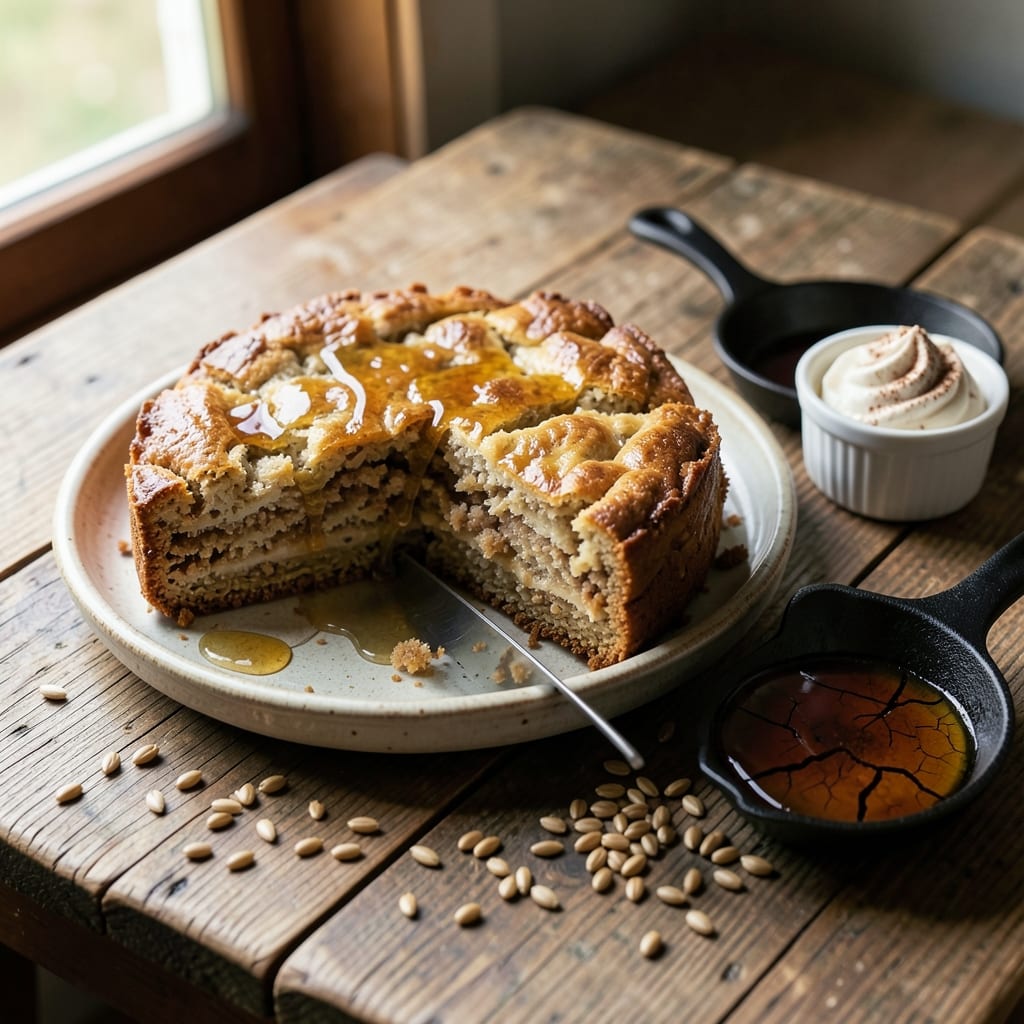
This ancient barley cake recipe transports you to medieval kitchens with its nutty, honeyed richness and satisfying crunch. 🌾 Barley flour—once a staple grain—adds earthy depth while keeping the texture wonderfully dense, perfect for slicing into thick wedges. The secret lies in balancing sweetness with warm spices like cinnamon and cardamom, creating layers of flavor that develop as it bakes.
What sets this cake apart is its historical roots, yet modern adaptability. Traditional recipes relied on honey for natural sweetness and preservation, while today we refine it with a touch of brown sugar for caramelized complexity. The cake rises just enough to create a tender crumb, but holds its shape beautifully—ideal for serving at room temperature or lightly warmed with a drizzle of honey.
The result is a dessert that feels both nostalgic and refined, with a nutty aroma that fills your kitchen and a satisfying crunch from toasted barley bits. Each slice offers a harmonious blend of sweet, spiced, and grainy textures, making it a showstopper for dinner parties or a cozy weekend treat. The best part? It keeps well for days, so you can bake once and enjoy for weeks.
Pair it with whipped cream, fresh berries, or a dusting of powdered sugar for an elegant finish. Whether you're exploring ancient grains or simply craving a dessert with depth, this recipe delivers—without sacrificing ease. Ready to bake?
Ingredients for ancient barley cake
Gather these earthy, honey-sweetened ingredients for a cake that tastes like history.
| Ingredient | Amount | Notes |
|---|---|---|
| Barley Flour 🌾 | 3 cups | Stone-ground for best texture |
| Honey 🍯 | 1 cup | Raw or wildflower preferred |
| Brown Sugar 🍚 | ½ cup | Light or dark, packed |
| Unsalted Butter 🧈 | 1 cup | Cold, cubed for mixing |
| Large Eggs 🥚 | 2 whole | Room temperature for blending |
| Vanilla Extract 🌿 | 1 tbsp | Pure vanilla for depth |
| Ground Cinnamon 🌶️ | 1 ½ tsp | Freshly ground preferred |
| Ground Cardamom 🌿 | ½ tsp | Toasted for enhanced aroma |
| Ground Nutmeg 🌶️ | ¼ tsp | Freshly grated if possible |
| Salt 🧂 | ½ tsp | Fine sea salt preferred |
| Whole Milk 🥛 | ½ cup | Room temperature for blending |
| Toasted Barley Bits 🌾 | ½ cup | For crunchy texture |
Barley flour is the heart of this cake, so don't skimp—it's what gives that satisfying crunch and nutty depth. Bob's Red Mill or King Arthur are my go-tos for quality, but any stone-ground variety works. If you can't find barley flour, substitute spelt flour at a 1:1 ratio, though the texture will be slightly less dense. Toasting the barley bits separately (just dry-toast in a pan until golden) makes all the difference—they should smell toasty and nutty. For the honey, local raw honey adds complexity, but any good-quality honey works. The spices? Buy whole spices and grind them fresh if you can—cardamom especially benefits from this treatment.
No cardamom? Skip it or use half the amount of cinnamon—it's not dealbreaking, but it does add that subtle medieval touch. Short on butter? Coconut oil or vegan butter works in a pinch, though texture may vary slightly. The milk can be any kind, but whole milk gives the best richness. For the brown sugar, light brown is slightly more moist, while dark adds more caramelized depth. If you're baking for a crowd, double the recipe—this cake keeps beautifully for 5-7 days wrapped in parchment. The toasted barley bits? Store them in an airtight container for up to 2 weeks—they're worth the extra effort.
This cake tastes even better the next day as the flavors meld, so bake it a day ahead if you can. Store wrapped tightly in parchment at room temperature for 5-7 days, or freeze slices for 3 months. To serve, dust with powdered sugar or drizzle with extra honey—I always make a double batch because it disappears fast. The crumb stays moist for days, but the toasted barley bits add that satisfying contrast. Perfect for slicing into thick wedges, serving with whipped cream, or packing for lunches—just like medieval bakers intended.
Why You'll Love This Recipe
- No-Fuss Mixing: I swear by this—just stir, pour, bake. Barley flour can be finicky, but here, it blends like a dream with honey and butter, no extra steps. The dough comes together faster than my coffee brews.
- Golden Honey Crunch: That caramelized edge from the brown sugar and honey? It’s the kind of sweetness that lingers. The eggs add richness, but the barley keeps it from being too heavy—like a warm hug in cake form.
- Breakfast or Snack Star: Honestly, I eat this cold with tea in the morning or reheated with butter for an afternoon pick-me-up. The texture holds up everywhere—no soggy slices here.
- Budget-Friendly Staple: Barley flour and eggs are wallet-friendly, and this recipe stretches further than most. I’ve made it for potlucks, last-minute guests, and even packed it for lunch—always a win.
Step-by-step instructions for ancient barley cake
Here's how to craft this nutty, honeyed barley cake with perfect texture every time.
👨🍳 Step 1: Mix Dry Ingredients for Flavor Foundation
In a large mixing bowl, combine the 3 cups barley flour, 1.5 teaspoons ground cinnamon, 0.5 teaspoon ground cardamom, 0.25 teaspoon ground nutmeg, and 0.5 teaspoon salt. Whisk vigorously for 1 minute until the spices are evenly distributed throughout the flour—this ensures consistent flavor in every bite.
I like to sift the dry ingredients first if I have a sifter, but whisking works perfectly too. The goal is to eliminate any lumps and create a fine, aerated base for the cake. Set this mixture aside for now—it's the flavor backbone of this ancient grain cake.
🍳 Step 2: Cream Butter and Sweeteners for Light Texture
In a separate large bowl, beat the 1 cup cold unsalted butter (cut into cubes) with the 1 cup honey and 0.5 cup brown sugar using an electric mixer on medium speed for 3-4 minutes. You're looking for a light, fluffy mixture that nearly doubles in volume and becomes pale in color—this incorporates air that will make your cake tender.
Here's the thing—don't rush this step. The butter needs to emulsify with the honey and sugar to create that perfect creamy texture. If you skip this, your cake will be dense instead of light. Scrape down the sides of the bowl every 30 seconds to ensure everything gets properly incorporated.
👨🍳 Step 3: Add Eggs and Wet Ingredients
Add the 2 whole large eggs (at room temperature) one at a time, mixing on low speed for 30 seconds after each addition. Then stir in the 1 tablespoon vanilla extract and 0.5 cup whole milk. Mix just until combined—you should still see some dry flour streaks when you lift the mixer paddle.
Overmixing develops gluten, which makes cakes tough. We want a tender, moist crumb here. The mixture should be thick but pourable. If it looks too stiff, add 1-2 tablespoons more milk to achieve the right consistency. This is where the cake's signature moisture comes from.
🥘 Step 4: Combine Wet and Dry Ingredients
Gradually add the dry ingredient mixture to the wet ingredients, mixing on low speed just until combined. Be gentle—you're not making pancakes here. Once fully incorporated, fold in the 0.5 cup toasted barley bits by hand using a silicone spatula. This gives the cake its signature nutty crunch and prevents them from sinking to the bottom.
Here's a pro tip: Don't overmix when adding the dry ingredients. You want to maintain as much air as possible in the batter. The batter should be thick but still able to be spooned easily. If it's too stiff, you can add another 1-2 tablespoons milk to loosen it up.
⏰ Step 5: Bake to Golden Perfection
Preheat your oven to 350°F and grease a 9x13-inch baking pan (or line with parchment paper for easy removal). Pour the batter into the prepared pan and smooth the top with a spatula. Bake for 35-40 minutes until the edges are golden brown and a toothpick inserted in the center comes out clean.
I know it seems like a long time, but this cake needs that extra baking to develop its full flavor and texture. The top should be beautifully browned with a slight crackle, and the edges should pull away from the pan just slightly. Let the cake cool in the pan for 10 minutes before transferring to a wire rack to cool completely.
Pro Tips For Making Ancient Barley Cake
- Whisk Eggs Like Mad: Barley flour’s grittiness loves air—beat those eggs until they’re pale, thick, and ribbon when you lift the whisk. I used to skip this, and the cake turned out dense and heavy. Five minutes of elbow grease makes all the difference.
- Melt Butter Slowly: Don’t rush the butter—warm it over low heat until it’s just liquid, not browned. Browned butter adds bitterness that’ll fight with the honey’s sweetness. Trust me, your cake will taste richer without the extra work.
- Skip the Overmixing: Barley flour develops gluten faster than wheat flour. Mix just until combined—lumps are fine, but a tough batter means a tough cake. Stop when the honey and sugar are evenly distributed.
- Test Doneness with a Skewer: The cake’s dense, so don’t rely on springiness—insert a skewer. It should come out clean or with one moist crumb. I learned this the hard way when my first batch turned out gummy because I pulled it too soon.
Common mistakes when making perfect results
Overmixing the Batter
This is the #1 mistake that turns tender barley cake into dense, tough bread. When you mix the wet and dry ingredients, stop as soon as they're just combined—you should still see small flour streaks. Overmixing develops gluten in the barley flour, creating a chewy texture instead of the delicate crumb we want. I've ruined cakes by mixing for too long, so set a timer for 30-45 seconds after combining. 💡
Skipping the Barley Bit Toast
Those toasted barley bits aren't just for crunch—they add depth of flavor! If you skip toasting them (or use raw barley), your cake will taste flat and lack that nutty, caramelized aroma. Toast them in a dry pan over medium heat for 3-5 minutes until golden and fragrant. Pro tip: Toast them separately so you can smell that perfect nutty aroma before adding to the batter.
Incorrect Oven Temperature
Baking at 350°F is critical—any hotter and the edges will burn before the center sets, while cooler temps leave it gummy. I've learned this the hard way! Preheat your oven for at least 20 minutes and use an oven thermometer to confirm accuracy. If your oven runs hot, reduce to 325°F and add 5-10 minutes to baking time.
Underbaking or Overbaking
The cake should bake until a toothpick comes out clean but with moist crumbs (not dry). Underbaking leaves it gummy, while overbaking makes it dry. I check at 35 minutes and bake another 2-5 minutes if needed. The edges should pull away slightly from the pan, and the top should be golden with a crackly crust.
Using the Wrong Flour
Substituting all-purpose flour destroys the cake's texture and flavor. Barley flour has a higher protein content that creates that satisfying density and nutty taste. If you must substitute, use spelt flour at a 1:1 ratio, but expect a slightly lighter texture. I've tried this substitution and while it works, it's not the same as the real deal. 🌾
Ignoring Room Temperature Ingredients
Cold eggs and butter create pockets of steam that can cause the cake to sink or develop a domed top. Take eggs out 30 minutes before baking and let butter sit at room temperature for 1-2 hours. I always make this mistake when I'm impatient—just let them warm up properly for perfect results every time.
Nutrition facts
Frequently asked questions
Can I make this barley cake gluten-free?
Barley naturally contains gluten, but you can adapt this recipe using a 1:1 gluten-free flour blend like Bob's Red Mill or King Arthur. Replace the barley flour with the blend and add 1 teaspoon xanthan gum to mimic the cake's structure. The texture will be slightly lighter, but it'll still deliver that nutty, honeyed flavor. Test small batches first to adjust liquid ratios.
How do I store leftovers to keep them fresh?
Wrap the cooled cake tightly in plastic wrap or aluminum foil, then place it in an airtight container. It stays moist and delicious for 5-7 days at room temperature. For longer storage, slice the cake and freeze individual portions for up to 3 months. Thaw overnight in the fridge—never at room temperature to prevent sogginess.
What's the best way to serve this cake?
Slice into thick wedges and serve at room temperature for the best texture. Dust with powdered sugar or drizzle with extra honey for an elegant finish. Pair with whipped cream, fresh berries, or a dollop of Greek yogurt. For a medieval twist, serve with spiced wine or warm spiced cider—just like ancient bakers would have enjoyed!
Why does my barley cake taste bland?
Bland flavor usually means the spices weren't toasted or mixed properly. Always toast your spices (especially cardamom) in a dry pan for 1 minute to release their aromas. Also, ensure you're using freshly ground spices—they lose potency over time. If your honey lacks depth, try using local raw honey or adding a pinch of sea salt to enhance flavors.
Can I bake this in a different pan size?
Yes, but adjust the baking time. For an 8x8-inch pan, bake 30-35 minutes (it's thicker), while a 9x13-inch pan takes 35-40 minutes. The cake should be golden with a clean toothpick test. If using a round 9-inch pan, reduce oven temp to 325°F and bake 40-45 minutes—it may need tenting with foil if browning too quickly.